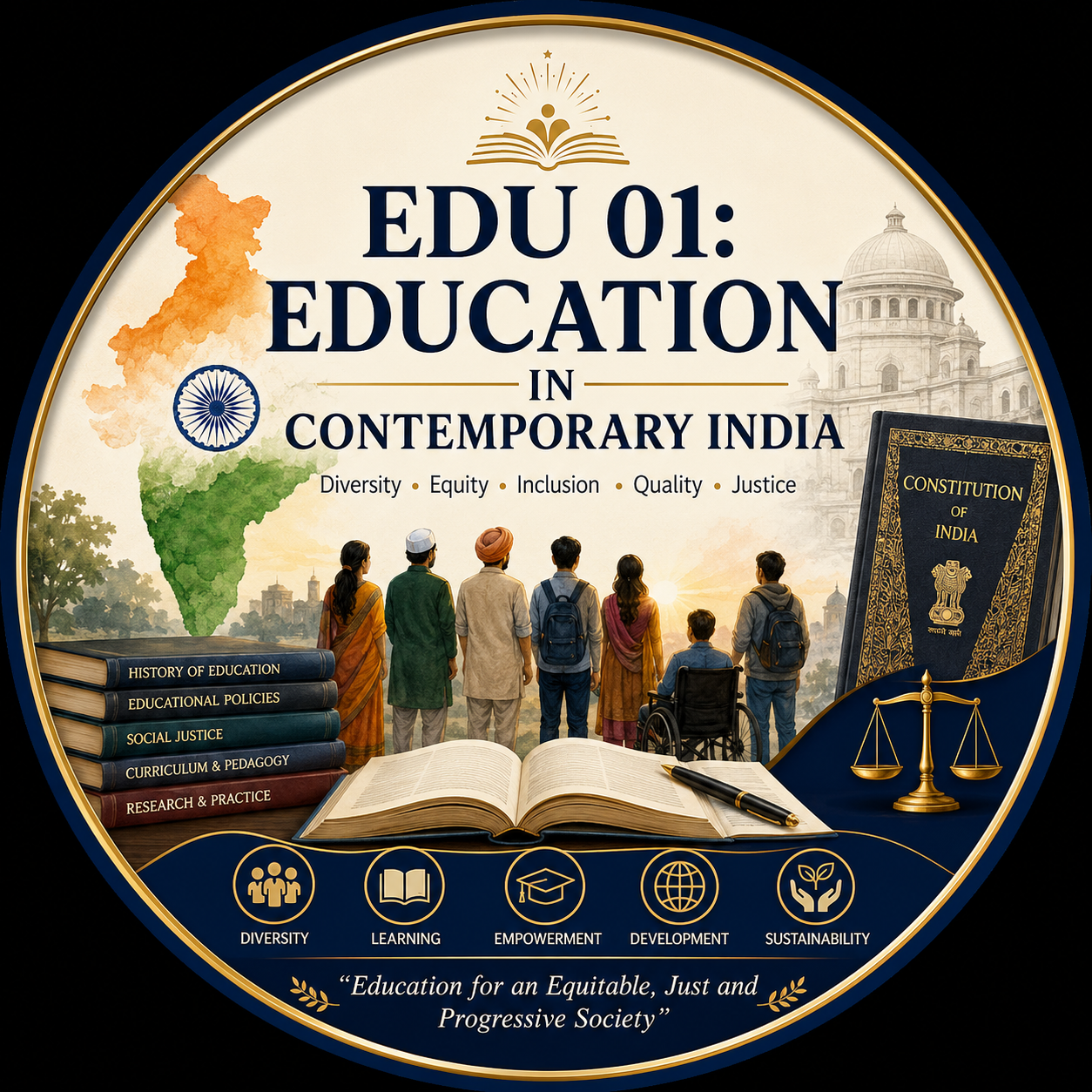
The course EDU 01: Education in Contemporary India focuses on understanding the relationship between education, society, constitutional values, educational policies, and social development in India, with particular emphasis on Kerala. It explores the historical evolution of education, the diversity of Indian society, the role of education in promoting equality and inclusion, and the contemporary challenges facing the Indian education system.
The course is organized into six units. Unit I: Features of Indian Society examines social, regional, linguistic, caste, class, tribal, racial, and physical diversities and explores the role of education in respecting diversity. Unit II: Education and Contemporary India introduces the meaning, definitions, functions, aims, types, and levels of education, along with its interdisciplinary nature. Unit III: Evolution of Education in India traces the development of education from ancient and medieval periods through colonial education, nationalistic alternatives, and Basic Education (Nai Talim). Unit IV: Constitutional Safeguards of Education focuses on the constitutional vision of India, the Preamble, fundamental rights and duties, directive principles, and the values of freedom, justice, equality, and fraternity, particularly in relation to educational inequality and marginalization. Unit V: Policy Framework of Public Education in India discusses major educational issues, commissions, policies, programmes, and curricular frameworks, including the Kothari Commission, NPE 1986, SSA, RMSA, the Right to Education Act 2009, NCF 2005, and NCFTE 2009. Unit VI: Education in Contemporary Kerala Society explores the historical development of education in Kerala, the contributions of educational and social reformers, education after the formation of modern Kerala, the Kerala Education Rules (KER), and curricular changes since the 1990s.
The course adopts diverse learning approaches, including lectures, seminars, small-group discussions, brainstorming sessions, field surveys, visits, and projects. Assignments encourage students to investigate the development of educational institutions, evaluate government-sponsored educational programmes and policies, and understand social and cultural diversity through field engagement.
Overall, the course aims to develop a critical understanding of Indian education in its historical, social, constitutional, and policy contexts, enabling prospective teachers to appreciate diversity, recognize educational inequalities, understand policy frameworks, and contribute to the development of an equitable, inclusive, and progressive educational system.
- Teacher: Mubarak P
- Teacher: Soumiya M S
EDU 03 – SCHOOL ORGANIZATION
Course Summary
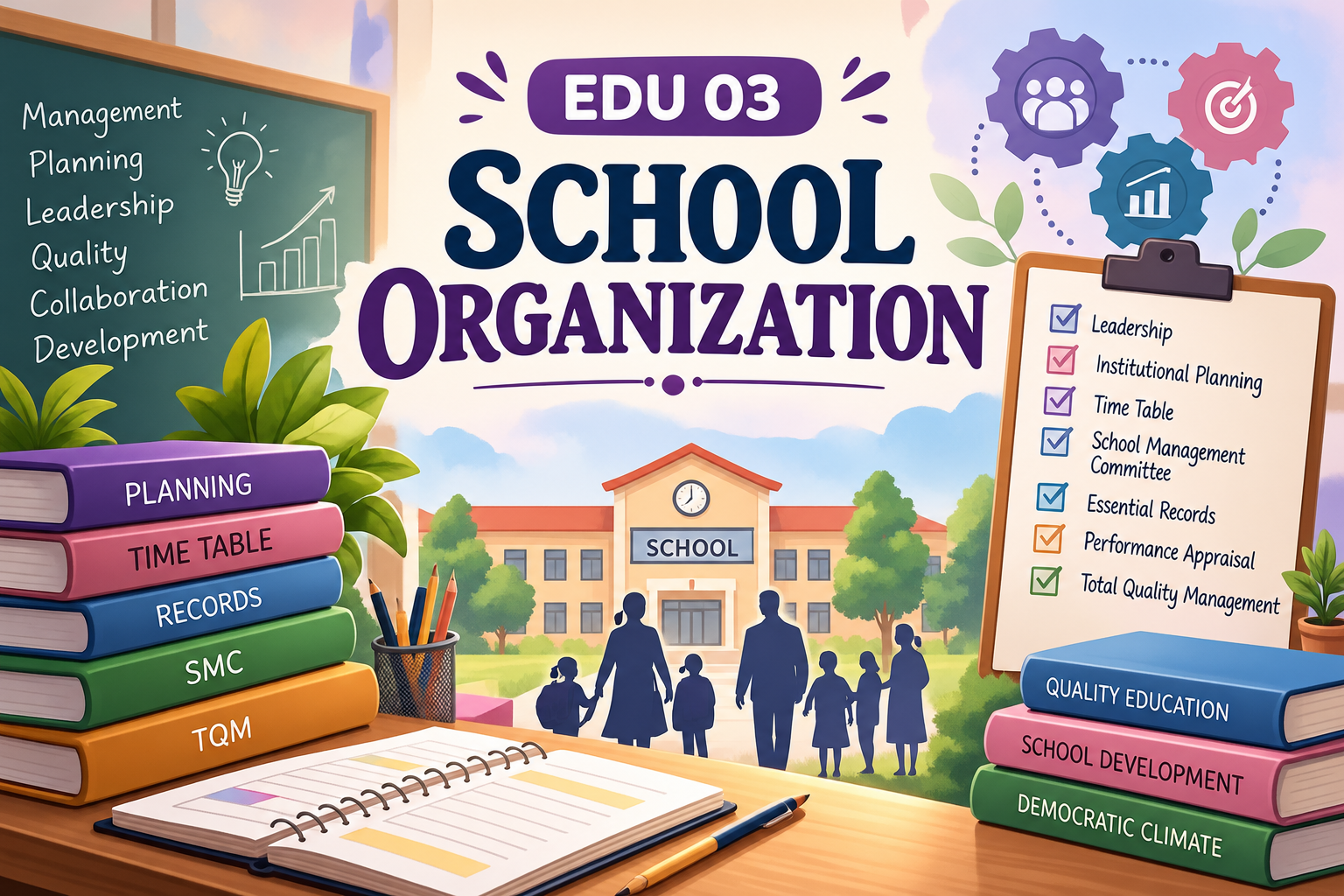
The course EDU 03 – School Organization aims to develop student teachers’ understanding of educational management, school organization, institutional planning, and quality management in educational institutions. It familiarizes student teachers with the principles and practices necessary for the effective and democratic functioning of schools.
Unit I: Educational Management deals with the concept, need, scope, and functions of educational management. It focuses on the characteristics of a democratic institutional climate, organizational processes in schools, and the role of the Headmaster/Principal as a leader. It also discusses the duties and responsibilities of the Headmaster/Principal, the meaning and importance of performance appraisal, and the appraisal of teachers. In addition, the unit highlights the importance of essential school records, including the Admission Register, Attendance Register, Stock Register, Acquittance Register, Teaching Manual, Student Profile, Cumulative Record, and Service Book.
Unit II: Institutional Planning introduces the meaning and importance of institutional planning and emphasizes the role of the School Management Committee (SMC), School Development Plan, staff council, and student council in school administration and development. It also explains the different types of timetables and the principles involved in timetable construction. Furthermore, the unit introduces Total Quality Management (TQM), its concept, and its scope in improving the quality of educational institutions.
Overall, this course equips student teachers with the knowledge and skills required for effective school administration, leadership, planning, record management, performance appraisal, and quality improvement. It promotes democratic participation, systematic organization, and continuous improvement in school functioning.
- Teacher: Dr. RESHMA P M
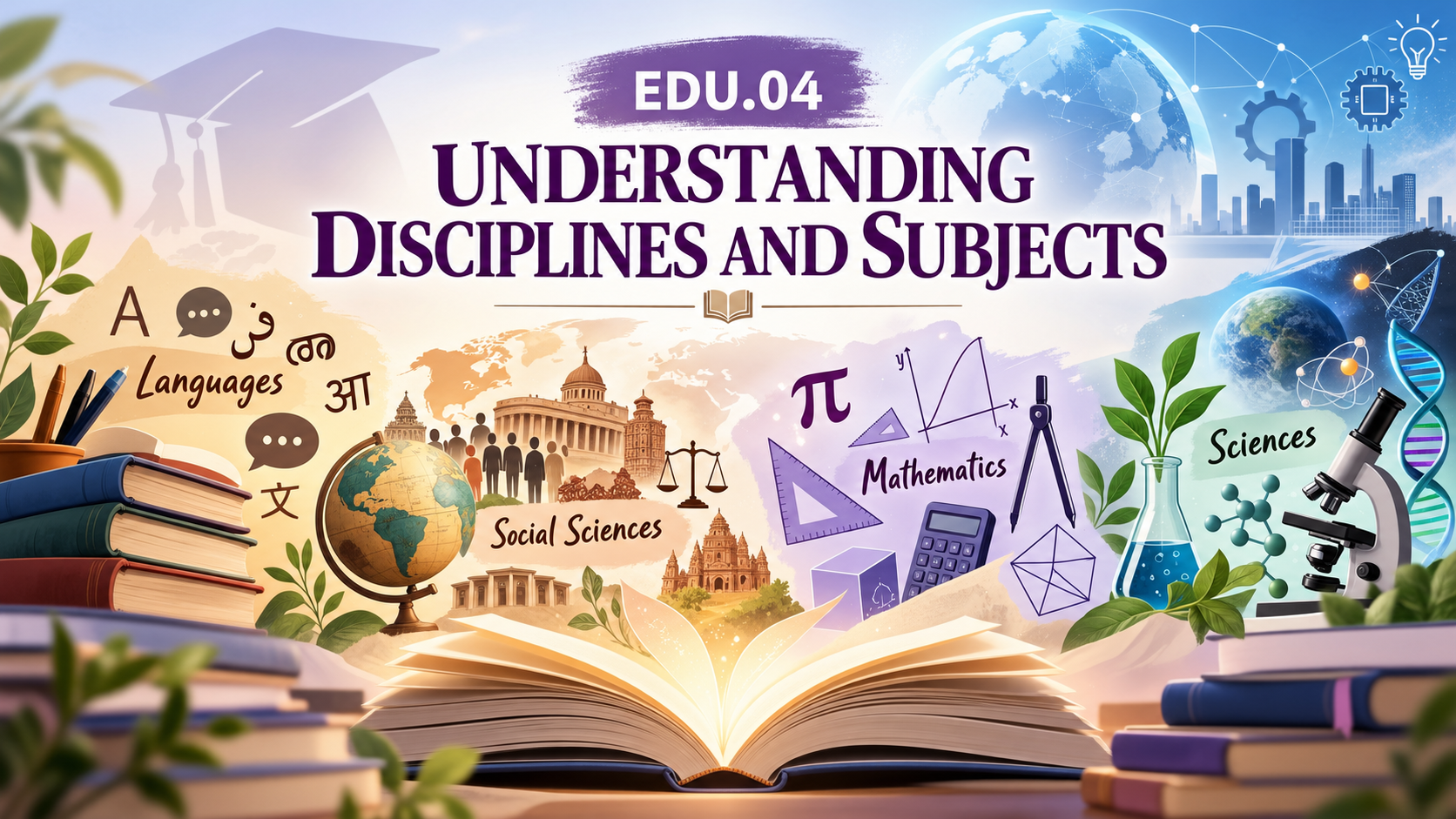
The course Understanding Disciplines and Subjects aims to develop student teachers’ understanding of the nature, significance, classification, and evolution of school subjects and academic disciplines. It familiarizes them with the major school subjects, including Languages, Social Sciences, Mathematics, and Sciences, and explains their importance in developing communication skills, social awareness, citizenship, scientific attitude, critical thinking, logical reasoning, and problem-solving abilities.
The course explores the meaning, characteristics, and classification of academic disciplines, including the Biglan Model, and examines the differences and relationships between school subjects and academic disciplines. It also introduces disciplinary, interdisciplinary, and multidisciplinary approaches to knowledge. Furthermore, the course examines the historical development and nature of Languages, Mathematics, Sciences, and Social Sciences, highlighting the social, political, and cultural influences on their evolution.
The course also focuses on the emergence of new academic disciplines in response to changing societal needs, scientific discoveries, technological advancements, specialization, and interdisciplinary research. Emerging fields such as Disaster Management, Nanotechnology, Gemmology, Bioinformatics, and Immunology are explored. Overall, the course enables student teachers to critically understand the development of knowledge and appreciate the relevance of different disciplines in contemporary education.
- Teacher: Dr. RESHMA P M
- Teacher: Mansoor V M
- Teacher: Dr. Samsu Firsad N
Ansar Training College for Women, Perumbilavu
Mathematics Option 2026-2028
- Teacher: Dr.Radhika T Thottungal
- Teacher: Haseena KV
- Teacher: MINI T J